
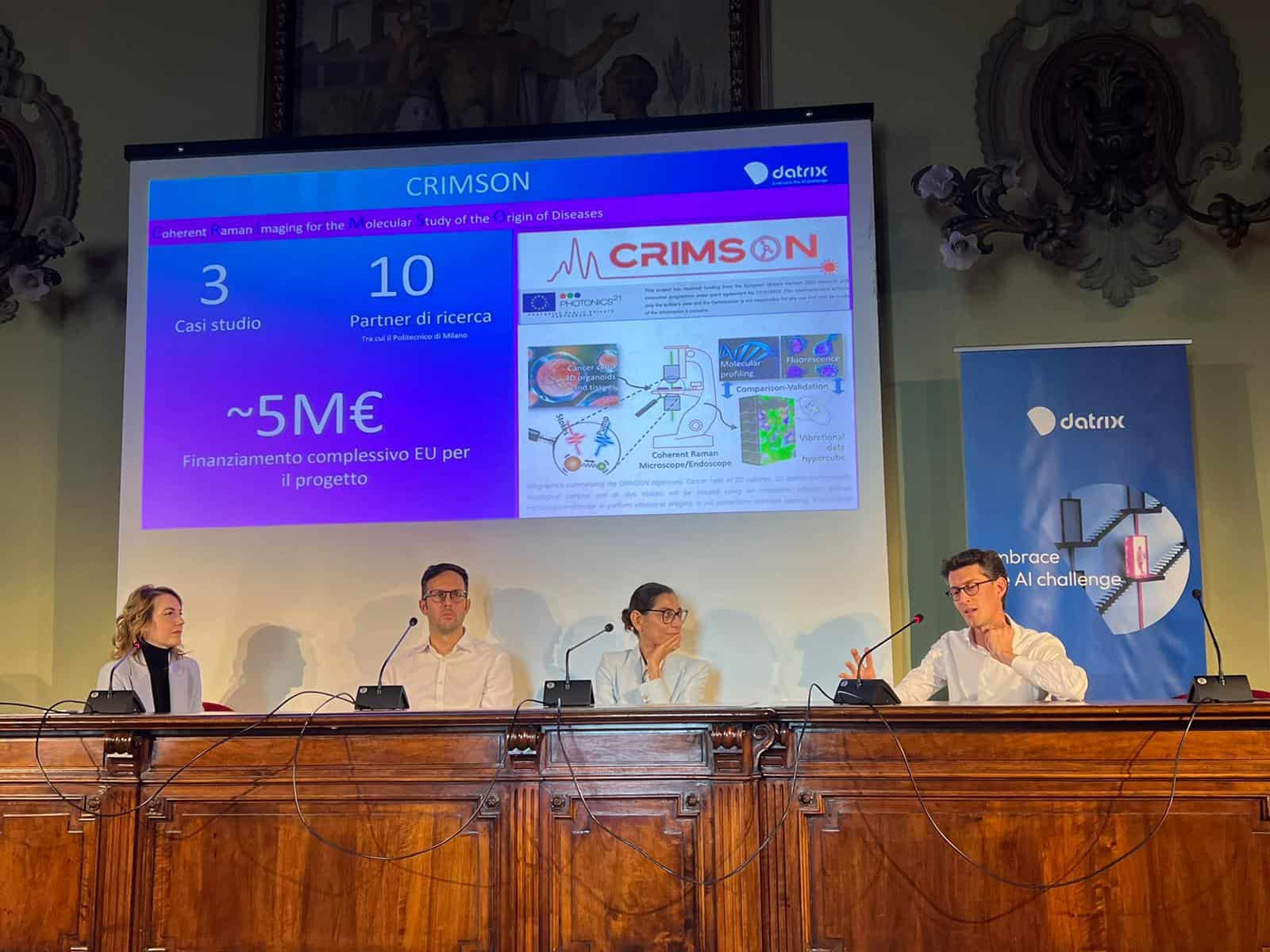
As part of Milan Digital Week 2024: The new language of the city between artificial intelligence and human expressions, Datrix took part in the seventh edition of the widespread and collective event in the city with a panel entitled “AI AND DATA: HOW ITALIAN TECHNOLOGY IMPROVES MEDICAL RESEARCH AND CARE”.
Martina Costa, CMO of Datrix, moderated the panel held in the Sala Parlamentino, at the central hub of Palazzo Giureconsulti. Among the speakers: Matteo Bregonzio, CTO and Head of R&D of Datrix, Stephana Carelli, Researcher at the Vittore Buzzi Hospital in Milan and Renzo Vanna, First Researcher of the CNR – Institute of Photonics and Nanotechnologies of the Politecnico di Milano.
From the more technological contribution of our CTO to the medical and biological perspectives of Carelli and Vanna, during the talks some of the AI-based technologies were presented, developed by Datrix’s internal R&D, which empower medical research and the positive impact on patient health as never before.
Starting from BETTER and the role of the Vittore Buzzi Hospital, through to Crimson and RamApp which saw the collaboration between Datrix, the Politecnico di Milano and the CNR, let’s discover the three projects more closely.

What are the main objectives of the BETTER project and how does Federated Learning technology represent a novelty for the rare disease sector? How is this project influencing research and the impact on patients?
Better represents a radical change in the world of rare diseases, a project that aims to develop innovative therapies and methodologies that significantly improve the quality of treatments for patients. Funded by the European Union, this project, for which Datrix is the international coordinator, involves a network of seven European hospitals that, thanks to Federated Learning technology, can share patient information and knowledge in a secure way that complies with privacy regulations.
“This advanced technology allows working with data within the perimeter of each hospital, without the need to centralize it, thus reducing the risks of privacy violations and complying with the latest European standards, such as GDPR and the AI Act”. It is clear, from the words of our CTO, that “Federated Learning not only optimizes processes in the medical sector, but has application potential in other sensitive sectors such as insurance and finance, where respect for privacy and transparency are essential”.
From a medical point of view, as Dr. Stefana Carelli highlights, European collaboration represents a unique opportunity: “not only data, but also clinical experiences and expertise are shared between hospitals in different countries, facilitating early diagnosis and treatment of rare diseases. For example, the collaboration with Buzzi is fundamental for advanced neonatal screening, which allows for the detection of over 40 genetic diseases in the first days of life, and for research in the field of autism, two areas that will benefit enormously from this integrated approach”.
BETTER introduces a change in mindset that concerns not only professionals and researchers, but also patients, who see the sharing of their data as a key to obtaining better treatments and clinical outcomes.
Better aims to make rare diseases ‘less rare’, creating a European database that reduces the isolation of these patients and their families, facilitating access to shared knowledge and therapies at a European level.
Thanks to Federated Learning, in fact, for the first time in history, the diagnosis and treatment of rare diseases become possible thanks to the sharing of clinical and genomic data from various international hospitals, without the need to centralize sensitive data. This innovative application of artificial intelligence allows for the preservation of patient privacy, making the most of the potential of genomic data to accelerate access to more precise diagnoses and targeted therapies.
But BETTER is not the only project related to the medical field on which Datrix’s Research and Development has worked and continues to work.
Could you tell us about the second European project CRIMSON? What is its objective, what technological contribution have you made, and how has this technology improved medical research and the care of oncology patients?
CRIMSON, another project funded by the European Union and coordinated by the Politecnico di Milano, with the participation of the CNR and the technological contribution of Datrix, aims to revolutionize oncology through an advanced microscope based on the Raman effect. “By exploiting the property of light to interact with matter, the Raman effect allows for non-invasive analysis of the chemical composition of biological samples, surpassing the use of traditional stains. It also allows for the visualization of molecules in oncological tissues and cells, revealing molecular details that conventional dyes cannot show,” explains Bregonzio.
Instead of relying exclusively on the pathologist’s visual expertise, CRIMSON allows for ‘reading’ the specific chemical structure of tumor cells, distinguishing diseased areas from healthy ones more quickly and accurately. This approach has the potential to anticipate diagnoses, reduce invasive biopsies, and allow for immediate action during operations, optimizing the timing of procedures.
In addition, the project introduces the value of artificial intelligence in the management and interpretation of hyperspectral images, a type of three-dimensional image extremely dense with information. “Datrix’s contribution to the data analysis part requires a very specific computational calculation and algorithmic set that can interpret the collected data, translating it into understandable results for the doctor who is thus aided in decisions.”
In summary, CRIMSON’s ambition is to complement or even replace the biopsy, enhancing the effectiveness of oncological diagnosis and proposing itself as a valuable support for pathologists, speeding up and objectifying analysis processes with a precision previously unthinkable.”
Vanna echoes: “this project offers a completely new approach. Although the traditional method with dyes continues to be used, CRIMSON allows for direct observation of the chemical composition of tissues through Raman. This not only enhances the visual experience but allows for the evaluation of specific molecules within tissues and cells, supporting the pathologist with a detailed analysis of molecular parameters and contributing to faster and more precise diagnoses”.
Thanks to AI technology and Datrix’s expertise, the interpretation of hyperspectral images allows for the rapid classification of tumor cells, even in complex cases such as leukemia.
Renzo further adds: “a significant example of this application concerns a study on leukemia, conducted using Raman technology for cellular analysis. This approach allows for the analysis of blood and bone marrow samples, where abnormal cells linked to the disease are detected. The technology allows for the automated classification of over 40 subtypes of leukemia, facilitating the work of doctors and providing fundamental support in contexts where access to expert pathologists may be limited. The goal is not only to assist the doctor in diagnosis but also to make it more objective and reproducible, improving access to timely evaluations in less served areas of the world, thus contributing to a positive impact on the quality of life and health of patients”.
Matteo, Renzo, as part of the CRIMSON project, you designed and co-developed RamApp, a free web tool for hyperspectral image analysis that was also cited by the prestigious international journal NATURE. Can you tell us what it consists of and why it is relevant for medical research?
Bregonzio gives us an initial overview: “RamApp was born from the desire to make hyperspectral technology accessible to doctors and researchers who are not computer experts, eliminating the complexities that often distance professionals from a full understanding of new technologies.” And adds: “RamApp is a free web tool that allows for the analysis of hyperspectral images generated by advanced microscopes, providing interpretable results in a short time. The system allows for uploading images, selecting pre-configured AI analysis modules, and obtaining clear and sharable results, useful for objective medical decisions. Simplicity of use is the heart of RamApp, which does not require advanced technical skills, while guaranteeing high-quality results.”
Finally, Vanna concludes: “The collaborative aspect is equally important: analysis results can be immediately shared with colleagues in other parts of the world, facilitating direct and multidisciplinary comparison. This distributed approach allows for aggregating multiple opinions on the same sample, making RamApp a fundamental tool for comparative research and knowledge sharing. RamApp’s cloud technology has been optimized to ensure efficiency and calculation speed, with an intuitive interface that allows for remote management of the computational load, without impacting the resources of individual devices.”
The adoption of RamApp by prestigious institutions such as MIT testifies to its international relevance and solid reputation in the global scientific community. The platform has also been cited in several international journals such as Nature and Science Advance, recognitions that attest to its innovative value and ability to improve medical research.
The entire event can be recovered here: