
This article was originally published on AI News on March 31, 2026 (Italian only).
The CEO of Datrix discusses what it means to bring AI into business processes: data, governance, verticalization, and the “Italian way” to artificial intelligence
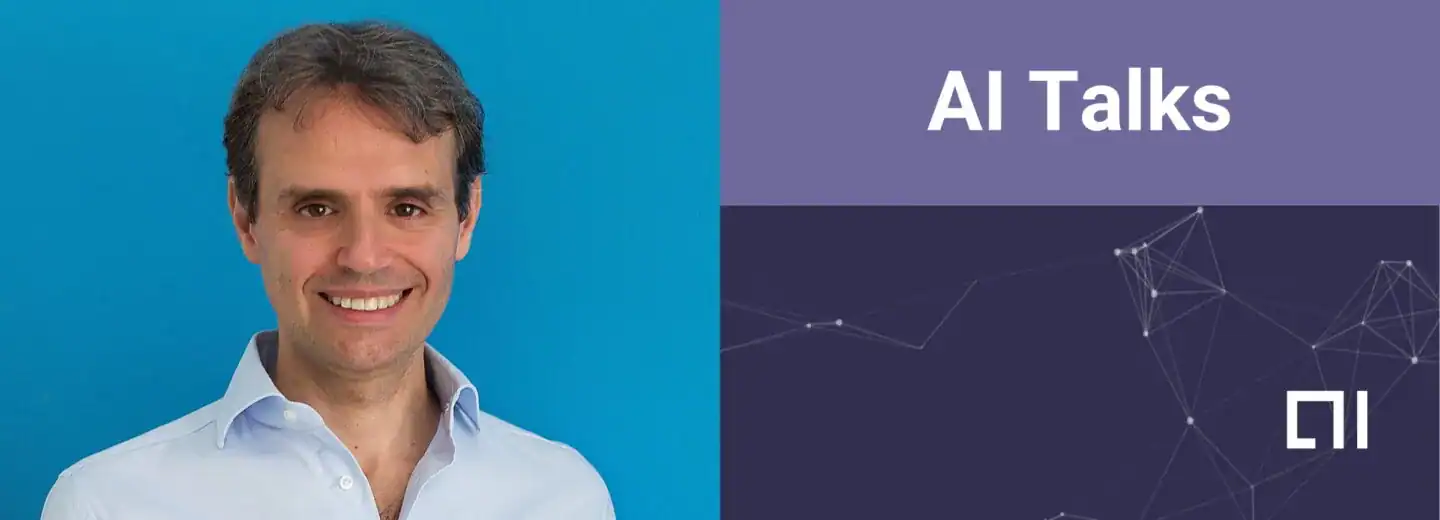
In this edition of AI Talks, our interview format exploring the world of artificial intelligence, we spoke with Fabrizio Milano D’Aragona, CEO and Co-founder of Datrix. A former top manager at Google Italy—where he actively contributed to the startup and scale-up phases of the Italian headquarters, focusing specifically on team growth and business development—he is currently the CEO and Co-founder of Datrix Group. He is also a board member of Assintel, where he coordinates the AI Think Tank, and IAB Italy.
Let’s start with a question we ask all our guests: what is artificial intelligence?
As I see it, artificial intelligence is neither technological magic nor an abstract entity: it is a set of systems capable of processing data, recognizing patterns, and generating predictions, recommendations, content, or decision-making supports useful to human activity. In other words, it is a technology that transforms data into operational capacity. To put it even more simply, AI serves to bring out value from information that already exists but often remains underutilized without the right tools. Today, companies collect massive amounts of data from customers, products, machines, and digital and physical touchpoints. The problem is no longer having the data, but knowing how to activate it. And artificial intelligence is exactly that: a system to activate data and make it useful for making better, faster, and more measurable decisions. This is why I tend to provide a very concrete definition: AI is a cognitive infrastructure that allows organizations to improve efficiency, decision quality, predictive capacity, and personalization. Naturally, different levels exist, from classic predictive models to generative AI and agentic systems. But the key point remains the same: not to replace human intelligence, but to augment it where it is truly needed.
You speak of artificial intelligence not as an abstract promise, but as a concrete tool for improving decisions and processes—what you at Datrix call “the AI of doing.” What does this mean in practical terms?
For us, “the AI of doing” means something very specific: moving from the idea of AI as a technological demonstration to AI as an industrial capability, integrated into a company’s real processes and evaluated based on measurable results. We aren’t interested in AI as a “showcase.” We are interested in AI that enters operational flows—in marketing, supply chain, logistics, production, finance, and risk management—and produces a verifiable impact. In practical terms, it means working on two fronts. The first is efficiency: reducing time and errors, intelligent automation, cost optimization, and higher productivity. The second is growth: using data to generate more revenue, improve conversions, increase customer lifetime value, reduce churn, and personalize offers and commercial decisions. These two dimensions—efficiency and data monetization—are the heart of the Datrix approach. Our vision is also closely tied to verticality. We don’t believe AI produces maximum value when it is generic and indistinct. We believe it works best when it is specialized, meaning when it understands the application context: finance, healthcare, utilities, retail, manufacturing, logistics. This is why Datrix defines itself as an ecosystem of vertical software companies powered by AI and focused on mission-critical sectors. Therefore, “the AI of doing” means fewer slogans, more concrete adoption; fewer proof-of-concepts disconnected from the business, more grounding in processes; less fascination with the model itself, and more attention to how that model shifts corporate performance and work quality.
Many companies claim they want to adopt AI, yet they often struggle to translate it into real processes. What are the most frequent mistakes you encounter when moving from strategy to implementation?
The most common mistake is starting with the technology instead of the problem. Many companies say, “we want to do AI,” but haven’t clarified which process they want to improve, which decision they want to make more effective, or which KPI they intend to move. When adoption starts this way, the risk is producing interesting demos that are ultimately of little use. The second mistake is thinking of AI as something standard that you just buy and install the same way for everyone. In reality, its value truly emerges when it is integrated with the specific wealth of knowledge each company already possesses: data, processes, industry language, operational skills, and know-how built over time. Even when AI is delivered through software, the domain expertise is what makes the difference, because it allows you to understand if the system is working well and where it generates real value. Another frequent error is starting with goals that are too ambitious or too long-term. Especially for an entrepreneur, it is often more effective to first identify areas where AI can quickly make a difference based on the company’s real internal conditions: the quality of available data, clarity of processes, team readiness, and the actual possibility of integration. That is where you should start, because early results build trust, method, and the capacity to scale adoption further. Then there is another often-underestimated knot: data quality and governance. Companies want intelligent systems, but they sometimes work with fragmented data, organizational silos, unclear rules, and undefined responsibilities. Under these conditions, AI amplifies the mess instead of creating value. This is why data maturity comes before model sophistication. Finally, I often see an artificial separation between AI, cybersecurity, compliance, and organization. In reality, these are now inseparable. A poorly governed AI system can create technical vulnerabilities, regulatory risks, and internal distrust. So, implementation isn’t just a technological issue; it’s also about culture, responsibility, transparency, and the ability to coordinate different functions.
Until 2009, you worked at Google. You witnessed from the inside the evolution of Google Italy during a phase when data and algorithms began transforming marketing, business, and decision-making processes. What has changed since then? And what has NOT changed?
First and foremost, the scale has changed. When I was at Google, we already saw clearly that data and algorithms would transform how companies understand the market, make decisions, and build products. But back then, this was perceived primarily as a competitive advantage for large digital players. Today, that is no longer the case. AI has become a general-purpose technology that can and must enter medium-sized enterprises, industrial chains, healthcare, services, and manufacturing. Speed has also changed. Today, the cycle between innovation, adoption, and impact has compressed enormously. Generative AI has made visible to the general public what was confined to specialist fields for years: the fact that machines don’t just classify or predict, but can also generate content, summaries, code, and operational support. This has accelerated expectations, investments, and competitive pressure. But one thing has not changed: the value is never in the algorithm alone. It lies in the ability to connect technology, data, distribution, business models, and managerial culture. Even back then, data was useless if not translated into decisions. The same holds true today. AI does not produce value automatically; it produces it when it is anchored in a clear strategy. Another aspect hasn’t changed either: platforms and ecosystems matter immensely. Back then, we saw the birth of an economy increasingly driven by digital platforms. Today, the same principle applies to AI. Those who build ecosystems, vertical capabilities, partnerships, and distribution hold a massive advantage over those who think adopting a single tool is enough. It is on this conviction that Datrix built its model.
In public debate, there is a lot of talk about models, computing power, and automation, but less—though slightly more lately—about governance. In your opinion, what is the most underrated skill for successfully leading AI within an organization today?
The most underrated skill today is the capacity for interdisciplinary governance. Leading AI well doesn’t just mean understanding models or choosing the right provider. It means knowing how to hold together technology, business, law, risk management, organization, and corporate culture. Many organizations still think of AI as a technical topic. In reality, it is first and foremost a managerial decision. Those governing AI must be able to answer very concrete questions: Where does AI create value? With what data? With what risks? With what responsibilities? With what human oversight? With what impact metrics? This type of expertise is still rare because it requires figures capable of standing at the boundary between different worlds. For me, AI governance has at least four pillars. First: data governance (quality, accessibility, traceability, and data responsibility). Second: risk governance (evaluation of impacts on rights, security, reputation, and operational continuity). Third: organizational governance (who decides, who validates, who monitors, who measures). Fourth: cultural governance (widespread training and the ability to help the organization understand how to use AI responsibly). Today, those who can integrate these levels will have a huge advantage, because AI will not just reward those who adopt first, but those who adopt best.
In recent years, new professional figures have emerged, including Chief AI Officers and AI trainers. What are the corporate roles of the future?
We will certainly see the growth of roles explicitly dedicated to AI, such as Chief AI Officers or AI Program Leads, but in my view, the true transformation won’t just be the emergence of new labels. It will be the birth of hybrid professionals capable of linking technology and operations. There will certainly be governance roles: Chief AI Officers, AI governance leads, AI compliance managers, and ethical-legal oversight figures, especially in regulated sectors. But “bridge” profiles will become increasingly important: people who understand business processes and are able to translate business problems into intelligent use cases. I’m thinking of three families of roles. The first is orchestrators: figures who coordinate cross-functional AI projects, bringing together IT, business, finance, legal, HR, and security. The second is adoption specialists: trainers, change managers, and knowledge architects—people who help the organization actually use these tools. The third is vertical specialists augmented by AI: marketers, controllers, HR managers, production leads, and logistics staff who don’t become pure technologists, but learn to work with intelligent systems integrated into their functions. Essentially, the future won’t just be made of new jobs. It will be made of existing jobs deeply transformed by AI. And those with the most value will be those who can combine domain expertise, the ability to read data, and an understanding of automation and governance logic.
From your perspective, is Italy building an ecosystem capable of truly competing in AI, or does it still risk remaining primarily an adoption market?
Italy has excellent skills, quality research, highly specialized companies, and a strong industrial culture. So, the potential to be more than just an adoption market is there. However, we must be realistic. Today, the risk of remaining predominantly a market that buys technology developed elsewhere still exists. Where can we truly be competitive? Not in replicating the massive American or Chinese general models. We can be competitive in applied, vertical AI integrated into our industrial districts—in manufacturing, health, energy, finance, the quality of “Made in Italy,” and advanced services. It is the “Italian way” to AI: less horizontal, more specialized; less based on pure scale, more on domain quality and adherence to production contexts. This is why I strongly believe in an ecosystem built on innovative SMEs, vertical software companies, applied research, universities, territorial chains, and European partnerships. A distributed model, not a centralized one. In this sense, Datrix moves in exactly this direction: aggregating and empowering vertical software SMEs with AI technologies, accompanying them through transformation and growth. The decisive point is avoiding two mistakes: thinking it’s enough to just import technology from the outside or, conversely, chasing the illusion of competing on the wrong ground. Italy can play a strong role if it invests in data, skills, vertical platforms, governance, and real industrial use cases. If it limits itself to the mere adoption of external tools without its own capacity, it will remain at the bottom of the value chain.
What do you think of the AI Act and Europe’s position in this global challenge?
I believe the AI Act represents an important and, in a sense, inevitable step. Europe has chosen to position itself not just as a market, but as a regulatory space capable of defining standards. This already happened with the GDPR, and today it is happening again with artificial intelligence. This approach has value: it asserts that innovation and the protection of rights should not be seen as irreconcilable opposites. That said, the quality of a regulation is measured not just in intentions, but in its concrete applicability. The risk always exists: creating excessive complexity, interpretive uncertainty, and disproportionate burdens, especially for European businesses and startups. Therefore, it will be essential to work well on the implementation phase—on guidelines, sandboxes, codes of conduct, and business support. I believe Europe is right to want to oversee themes of transparency, security, human oversight, and the protection of fundamental rights. But for this choice to be successful, it must be accompanied by a real industrial policy: investments in computing, talent, infrastructure, applied research, technology transfer, intelligent procurement, and support for European software companies. Regulation alone is not enough. I share the idea of a reliable, human-centric European AI. But this vision only makes sense if we build competitive capacity alongside the rules. The real challenge for Europe is not choosing between innovation and responsibility. It is managing to hold both together credibly.
When talking about AI applied to business, returns are often measured in terms of efficiency and ROI. You, however, also point to sustainability and the impact on people’s lives. How do you balance competitive advantage and responsibility?
I don’t see a contradiction between competitive advantage and responsibility. Rather, I see an increasingly strong convergence. In the medium term, AI that is not responsible also becomes less competitive, because it generates reputational, regulatory, organizational, and even economic risks. A company that uses AI well must certainly measure efficiency, productivity, ROI, and cost reduction. But it must also ask if it is building systems that are understandable, traceable, secure, and consistent with the human context in which they operate. In sectors like health, finance, labor, public administration, or critical manufacturing, this question is not incidental. It is central. Sustainability, in this sense, has at least three levels. The first is economic: AI must create real, lasting value, not just initial enthusiasm. The second is organizational and social: it must improve work, not simply compress activities without redesigning skills and responsibilities. The third is ethical and regulatory: it must respect rights, contexts, and proportionality of use. When these dimensions are held together, AI becomes a lever for the quality of the corporate system. And I would add: for a European entity like Datrix, this approach is also about identity. We want to contribute to useful, accessible, and responsible innovation, not a technological race for its own sake.
What do you think of the AI bubble?
I believe that within the AI phenomenon, two different things coexist: deep, real innovation and an evident component of hyperbole. As often happens during major technological discontinuities, the market tends to overestimate short-term effects and underestimate long-term ones. Yes, an element of a bubble exists—in valuations, expectations, language, and the tendency to call any somewhat sophisticated automation “AI.” This is physiological. Every time an enabling technology emerges, an euphoria phase is created where capital, narrative, and positioning move faster than the fundamentals. But reducing everything to a bubble would be a mistake. AI is not a passing fad; it is a structural transformation. It will change software, industrial processes, service models, marketing, healthcare, finance, and individual and organizational productivity. What we will likely see is a very sharp selection. Many generic promises will disappear, while players capable of bringing AI into production in a credible, measurable, and verticalized way will grow. In this sense, the question is not if the bubble will burst. Some speculative components will certainly deflate. The real question is: which business models will remain standing when the euphoria ends? I believe those based on concrete applications, proprietary data, domain expertise, process integration, and governance capacity will remain.
Looking at the next three to five years, how do you imagine the AI and tech market?
In the next three to five years, I see a market that is much more selective, more industrial, and less “demo-driven.” The phase ahead will be one of consolidation: less fascination with the technological proof itself, and more demand for integrated, reliable, measurable, and governable solutions. I see five main trajectories. The first is verticalization: AI will continue to spread, but true value will concentrate in specialized applications for sectors and functions. The second is integration: AI systems will no longer be external layers, but native components of enterprise software and decision-making processes. The third is governance: compliance, risk management, cybersecurity, and data quality will become structural parts of the offering. The fourth is industrial consolidation: acquisitions, aggregations, and alliances will increase because scale, distribution, and combined technological assets are needed. The fifth is the growth of applied European AI, especially in regulated and mission-critical sectors. I also believe that the boundary between traditional software and AI software will tend to disappear. We will say “this is an AI product” less and less, and instead say “this product works better because it incorporates intelligent capabilities.” AI will become a pervasive dimension of software, not a separate category. In parallel, the market will reward those who can combine two things: technological power and trust. Companies will buy not only performance, but also reliability, explainability, security, operational continuity, and the ability to adapt to regulatory contexts. That is where the real game will be played, especially in Europe.
To close, what is the cliché or false myth about AI that annoys you most and that, if you had a magic wand, you would debunk once and for all?
The false myth that annoys me most is this: that AI is either a magic wand that solves everything or an inevitable threat that will render human work meaningless. Both these narratives are wrong, and above all, they are unhelpful. AI is not magic. Buying it isn’t enough to become more competitive. Without data, processes, skills, governance, and strategic vision, it doesn’t work. But it is also not an autonomous force that decides the fate of organizations on its own. AI remains a technology designed, adopted, and governed by people. We must learn to use it well. If I could debunk a cliché, I would debunk the idea that the heart of the matter is “man vs. machine.” The real question isn’t if the machine will replace the human. The real question is which organizations will better redesign the relationship between human intelligence, data, automation, and responsibility. Those who do it well will grow. Those who remain stuck between fear and slogans will fall behind. And I’ll add one last thing: AI must not become the privilege of a few large groups or a few Big Tech firms. The true challenge is making it a transformative tool accessible also to SMEs, supply chains, and the industrial sectors that constitute the real European economy. That is where a decisive part of our continent’s competitive future will be played.