

This article was originally published on MIT Technology Review Italia on May 4, 2026 (italian only).
The CEO as Chief Engineer of the Enterprise
Crossing the AI “Chasm” means bridging the abyss between technological adoption and the real transformation of the enterprise: moving away from the logic of purchasing tools and toward the engineering of the enterprise. The companies that will win are those capable of redesigning how they produce knowledge, coordinate work, and make decisions.
Eurostat reports that in 2025, 20% of EU companies with at least ten employees used AI technologies, while the Artificial Intelligence Observatory of the Politecnico di Milano estimates Italy’s AI market at 1.8 billion euros, having grown 54% over the past three years and accounting for approximately 5% of the national ICT market. The numbers indicate acceleration, not whether the direction is the right one.
The Wrong Frame for Adoption
Talking about AI adoption is misleading. It sounds practical, but it places AI alongside ERP, CRM, SaaS, cloud migration, or digital transformation. From there come the usual questions: which platform to buy, which pilots to launch, how many people to train, how quickly to scale use cases. These are questions about tools. They are not enough.
Generative and agentic AI does not only change how an enterprise records, retrieves, or automates work. It changes how it produces and defends knowledge, filters information, distributes attention, formulates problems, prepares options, coordinates activities, and exercises judgment. The object of strategy is no longer the tool: it is the enterprise system.
This is why the CEO must become Chief Engineer. This does not mean software engineer or technical specialist. It means taking responsibility for the engineering of the enterprise: the deliberate design of the company as a socio-technical system made up of people, models, data, workflows, interfaces, controls, incentives, escalation paths, and judgment.
The managerial enterprise coordinates through hierarchies, budgets, and reporting. The engineered enterprise coordinates through architectures: data, models, workflows, controls, audit trails, and human judgment embedded in systems.
MIT neuroscientist Tomaso Poggio and Theodoros Evgeniou of INSEAD warned readers of MIT Technology Review Italia that leaders unable to understand the nature of AI can become part of the problem: accelerating the obsolescence of their own organizations or making them dependent on third parties. This is not generic literacy. It is a deeper question: what does serious understanding require when the technology is powerful, fast, and still not explained by a mature scientific theory? It requires architectural robustness.
The strategic question is not to buy AI faster than competitors. It is to become an organization capable of governing intelligence, dependency, uncertainty, and judgment as components of its own operational architecture.
The Sovereignty of the Backbone and the Intelligence Supply Chain
In traditional strategy, ecosystems are networks of partners. In the age of AI they become structures of interdependence. The intelligence supply chain runs across chips, compute capacity, frontier models, cloud, APIs, data centers, energy, talent, regulation, and geopolitical influence. What looked like technology procurement becomes strategic autonomy.
The deepest risk is that critical processes depend on an external layer of intelligence whose conditions the enterprise does not control: API prices, exfiltration of sensitive data, privacy constraints, export controls, changes to safety layers, service interruptions, model deprecation, data residency rules, geopolitical constraints. A procurement decision becomes strategic exposure.
The answer is to make modularity a strategic requirement. Design Rules by Baldwin and Clark remains the correct mental model: complex systems become governable when interfaces, abstraction layers, and design rules allow components to be changed without rebuilding the entire system.
In the AI enterprise this means an internal interface layer with models, capable of decoupling workflows from a single provider; a distinction between proprietary data assets and external model execution; portability across cloud, hybrid, on-premise, open-weight, and proprietary stacks; contractual and technical fallbacks, multi-provider routing, and reduced but functional operating modes, designed before a crisis makes them necessary.
Strategy stops being “choosing the winner.” It becomes “designing so that the winner matters less.”
For European companies there is an additional dimension. The EU AI Act embeds risk, accountability, and auditability into the institutional context of AI systems. Architecture becomes a condition of traceability, defensibility, and strategic control. A company that cannot change models, abandon a vendor, protect proprietary data, inspect flows, or operate in degraded mode has not adopted intelligence. It has imported dependency.
This direction is also visible in the offerings of the major hyperscalers. Google presents AI sovereignty not as a product, but as architectural choices: data boundaries, dedicated cloud, distributed infrastructure, air-gapped environments, data-in-use protection, infrastructural autonomy, proprietary and open-weight models, agent control. Alongside its historic cloud, it offers open-weight models such as Gemma, usable on-premise or in a private cloud. Enterprise AI sovereignty is not purchased like a license. It is built internally, layer by layer.
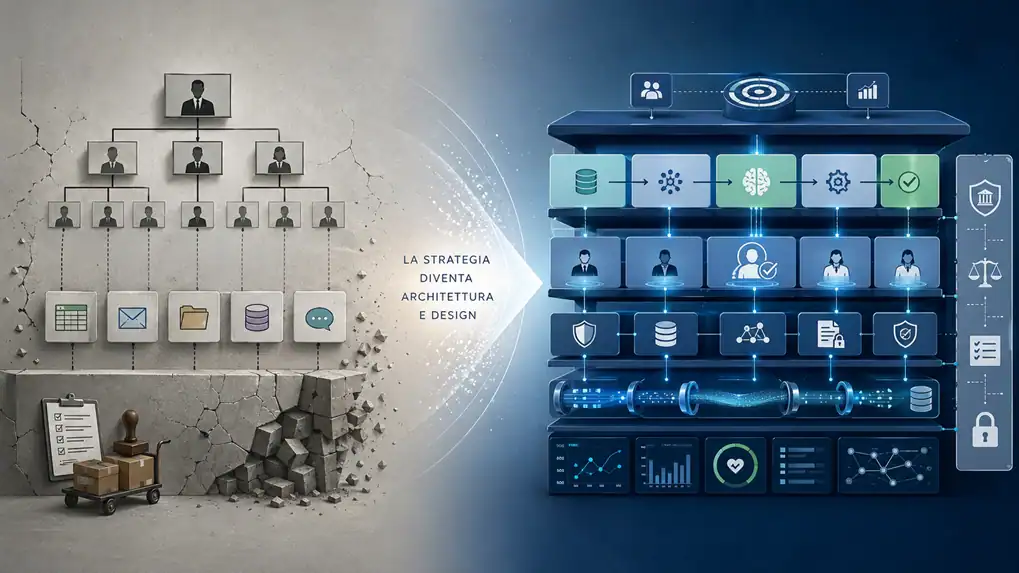
AI sovereignty as architecture: from dependency on the external supply chain to the engineered enterprise backbone. Source: author’s elaboration with generative AI, 2026 (italian).
The Work System Matters More Than the Model
Recent data shows that GenAI performance is “jagged”: it excels at some complex tasks and fails surprisingly at others that appear simpler. Value, therefore, does not arise from the tool itself, but from the way it is embedded in the work system. Dell’Acqua and others demonstrate this in the 2026 article in Organization Science, Navigating the Jagged Technological Frontier: AI assistance improves performance when tasks fall within the system’s capability frontier and damages it when they fall outside.
This evidence breaks the linear narrative about productivity. Value emerges when the enterprise designs the work system around the tool.
Socio-technical systems theory has long argued that social and technical subsystems must be optimized together. With generative and agentic AI this becomes workflow engineering: task decomposition, human checkpoints, evaluation systems, error budgets, escalation paths, safe failure modes, and tools that make AI observable and explainable in operations.
This is governance by design, not governance delegated to policy. Policies constrain behavior on paper. Engineered workflows constrain it in practice.
Noy and Zhang’s experiments on generative AI and writing tasks point in the same direction: AI can reduce time and improve quality in bounded activities, but outcomes depend on task, worker, incentives, evaluation method, and workflow.
The managerial enterprise buys tools and awaits use cases. The engineered enterprise specifies the conditions for safe scaling: decision rights, permissions, telemetry, evaluation routines, escalation logic, boundaries within which models can act, suggest, explain, or stop.
The CEO does not directly manage prompts or pipelines. The CEO is responsible for the architecture that determines how those systems enter business decisions. When AI mediates knowledge and action, the design of the enterprise becomes a strategic responsibility.
Cognitive Atrophy
The most-discussed AI risk in enterprises is hallucination. It is real, but it is not the deepest. The deepest risk is the erosion of human and organizational judgment.
When generative AI becomes the default interface to information, it shapes what human beings see before they even reason. Summaries, rankings, drafts, code suggestions, reports, meeting notes, search results, recommendations, and dashboards arrive pre-processed. The article by Chiriatti and others in Nature Human Behaviour, The case for human–AI interaction as system 0 thinking, describes this AI-mediated layer as a level that operates before Kahneman’s intuitive System 1 and deliberative System 2.
For business strategy this is decisive. System 0 does not merely answer questions. It shapes the field from which questions emerge. It can narrow options, smooth ambiguity, fill gaps with plausible priors, suppress weak signals, and make a premature conclusion feel like clarity.
The result can be organizational cognitive atrophy. People stop formulating independent hypotheses, teams stop challenging the frame, managers become editors of machine-generated summaries. Competence weakens because no one traverses ambiguity anymore. The organization knows how to use the tool, but does not understand the system on which it depends.
The answer is epistemic engineering: workflows that preserve judgment by imposing verification, active formulation, and disciplined dissent.
In high-stakes domains, teams should formulate independent human hypotheses before consulting the model. Generation and evaluation must be separated, so that a single output does not become the default truth. Internal benchmarks and red teams must be permanent infrastructure. Enterprises must monitor whether people can still explain, audit, challenge, and reformulate the systems they rely on.
Curiosity belongs to this architecture as a strategic capability. It fuels exploration, learning, and better problem formulation. The engine of questions must remain human, because curiosity and tacit knowledge enable collective sense-making that a black-box system, trained on past and visible data, cannot reproduce.
AI can broaden the search. It must not become the sole author of the frame. An enterprise that loses curiosity loses strategic perception. It can keep producing reports, forecasts, dashboards, and recommendations — even faster. But inside frames it no longer owns.
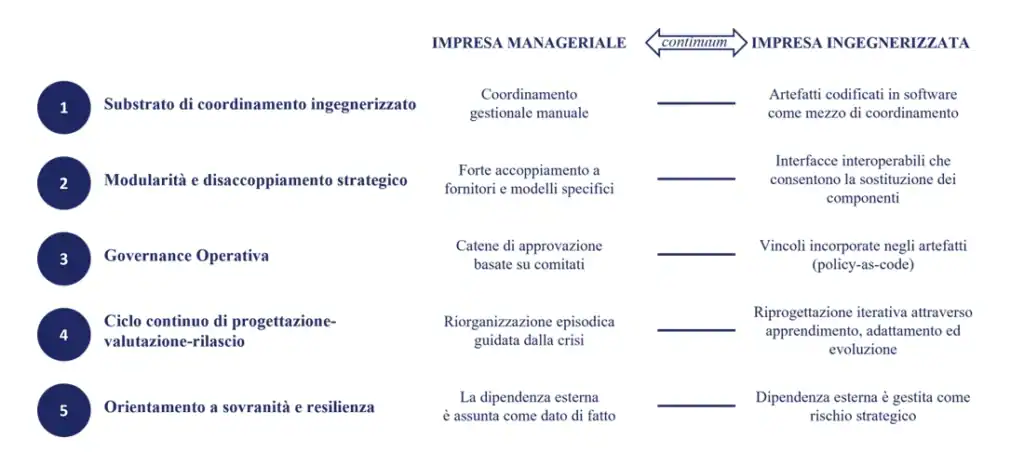
Table 1. From the managerial enterprise to the engineered enterprise. Source: author’s elaboration, 2026 (italian).
The Engineered Enterprise
These three shifts — modularity, socio-technical engineering, and epistemic discipline — define the rise of the engineered enterprise. The twentieth-century managerial enterprise coordinated through hierarchy, planning, budgeting, reporting, and administrative control. Chandler’s The Visible Hand described the managerial enterprise as a structure capable of coordinating scale and complexity. The engineered enterprise coordinates through designed artefacts: interfaces, model layers, data pipelines, workflow systems, test and evaluation systems, permissions, telemetry, red team routines, governance mechanisms, and feedback loops.
Herbert Simon’s The Sciences of the Artificial offers the deepest logic. Organizations operate increasingly in worlds constructed by design, not given by nature. Competence depends on the ability to deliberately model artificial systems: constraints, interfaces, feedback, and purposes.
This is where the distinction between strategy and design collapses. In the age of pervasive AI, you cannot govern what you have not designed. Table 1 briefly summarizes five key dimensions that change with the engineered enterprise: managerial coordination, modularity, operational governance, continuous adaptation cycle, sovereignty, and resilience.
A Series on Enterprise Design in the Age of AI
This article opens a series curated by Datrix on enterprise design in the age of AI: how to engineer an organization when AI enters its circuits of knowledge, coordination, and judgment. Some of the topics that merit deeper exploration are:
- Data: quality, governance, permissions, and audit trails.
- Knowledge: how to retrieve, recombine, and reuse institutional knowledge without losing context, provenance, and judgment.
- Work: application design and AI transformation, task decomposition, human intervention, and anomaly escalation.
- Control: AI governance as executable infrastructure, with logs, evaluations, provenance, approval gates, and monitoring.
- Openness: collaboration with external models, SMEs, universities, suppliers, and ecosystems without losing strategic autonomy.
These topics share one question: how should an enterprise be designed when its circuits of knowledge and coordination pass through systems it neither fully understands nor fully controls? In the age of AI, enterprise design becomes an executive function.