
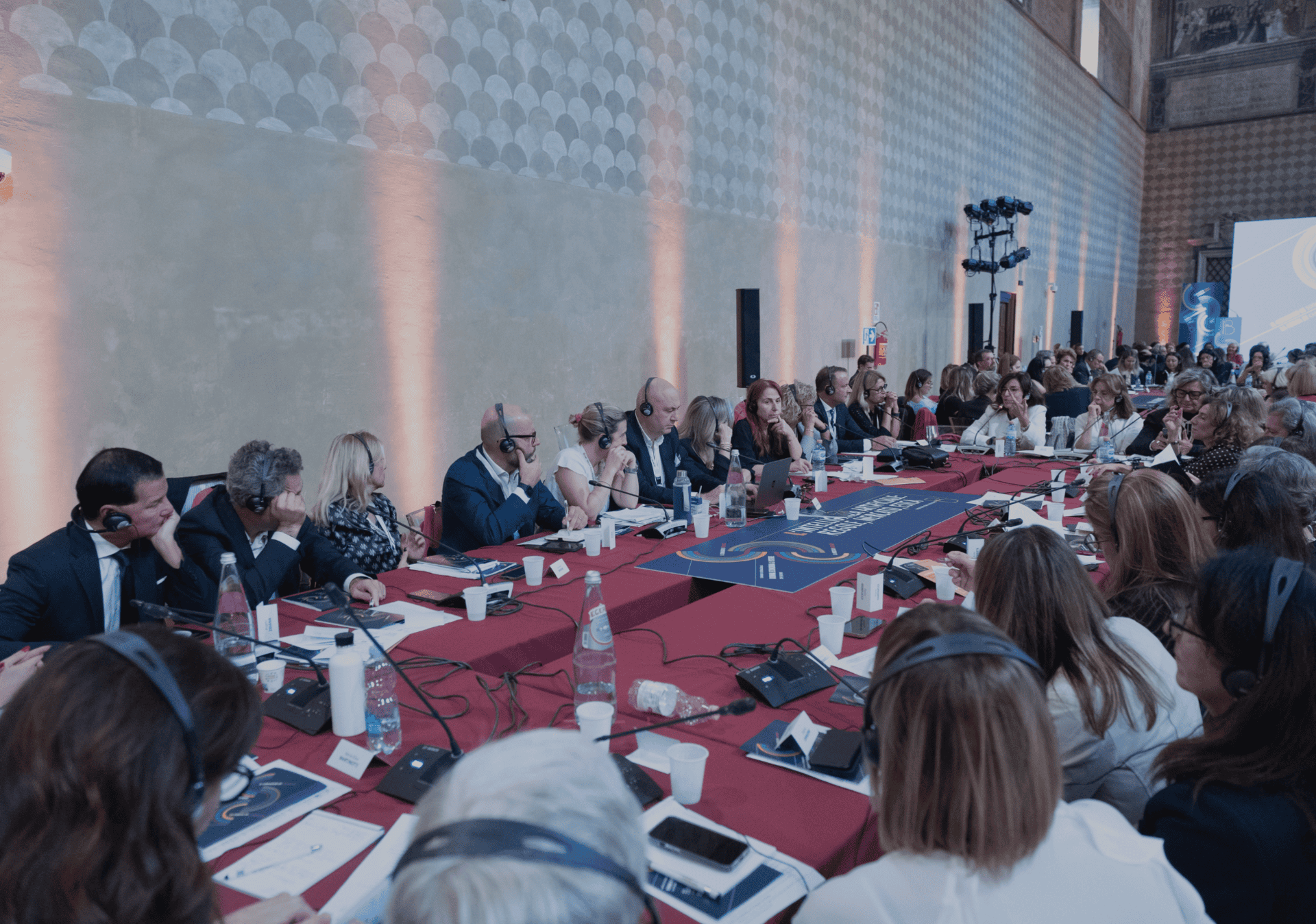
In its 24th edition, the Woman, Economy and Power event, organized by the Marisa Bellisario Foundation, saw the participation of Mauro Arte, General Manager and Co-Founder of Datrix, at the discussion table Artificial Intelligence: Rules, Market, Ethics.
The objective of the panel, moderated by Carlo Alberto Maffè – Professor at Bocconi University School of Management, was to explore how AI is influencing the job market and the development of new rules and regulations, in addition to the economic and organizational landscape of businesses and public administrations, highlighting ethical challenges and considering how Europe and Italy are positioning themselves within this context, with a look at geopolitical implications.
On this occasion, we collected statements from Mauro, who offered us an exclusive overview of the topics discussed during the meeting, bringing to light the most relevant themes and current challenges in the technological and regulatory fields.
The regulation of artificial intelligence occupied a central position in the debate. European measures, as Mauro Arte states, “although they represent an important first step, must find a balance between the need for ethical leadership and the need not to hold back industrial development. In a scenario where the United States and China are rapidly developing their technology, often without the European constraints related to privacy and fundamental rights, it is crucial to avoid excessive regulatory rigidity that could penalize Europe and, in particular, SMEs and startups.”
The world of work is already undergoing significant transformations due to AI. According to research by Goldman Sachs, 75% of today’s professions could be significantly modified in the coming years, but new professional figures are also being created such as that of the data scientist, now present in many companies. “The main challenge will therefore be to guarantee adequate and versatile training, which combines technical, humanistic and creative skills, to prepare workers for a constantly evolving context, where analytical skills and an ethical understanding of AI will be required” observes Mauro.
Addressing the theme of Europe’s technological and infrastructural challenges in AI, Arte explains: “Europe possesses a very vast information heritage thanks to its base of SMEs operating in various strategic industrial sectors and the digitalization that occurred with Industry 4.0, factors that make it potentially competitive in the application of AI in the industrial field. However, it is essential that regulations protect European technological sovereignty, to prevent large American players from dominating the market. The vision of Datrix, for example, aims precisely at this, valuing AI as a tool for efficiency and productivity for SMEs, without sacrificing data privacy and security.”
He continues: “although the growth of open-source algorithm libraries has stimulated innovation, it has also imposed limits. American academic research, influenced by large US tech companies, is increasingly focusing on generative AI, such as Large Language Models (LLMs), neglecting industrial application and Industry 5.0. From this perspective, the Datrix Group focuses on industrial AI, where it sees a field of application with ample room for growth, in which Europe can assume a leadership role, while on the contrary, in the field of generative AI, the gap with the United States is difficult to close, both in terms of technological differences and invested capital.”
A further aspect that emerged during the discussion concerns the ethics and sustainability of AI. “Artificial intelligence must not be a ‘black box’, but rather a clear and understandable tool that operates within open and transparent systems. Industry 5.0 in fact aims to combine AI with human creativity, with the aim of promoting sustainability and addressing environmental and social challenges. In this context, training plays a crucial role: the integration of different skills and cultures can reduce bias, favoring an ethical use of technology while improving the reputation and productivity of companies” concludes Mauro.
It is therefore clear how artificial intelligence represents not only a technological challenge, but also an extraordinary opportunity to redefine the labor market, improve productivity and promote ethical and sustainable leadership at a European level. Its future will depend on the ability to balance innovation and governance, allowing companies to grow and innovate without giving up respect for fundamental rights and European values.


PRESS REVIEW
On December 9, attached to Il Sole 24 Ore, the insert Le Protagoniste will be at newsstands, dedicated to the 24th edition of Donna Economia & Potere, where it will be possible to find the story, report and photos of the two days of work.